
Showing posts with label pagan. Show all posts
Showing posts with label pagan. Show all posts
Friday, March 30, 2018

Sunday, April 16, 2017
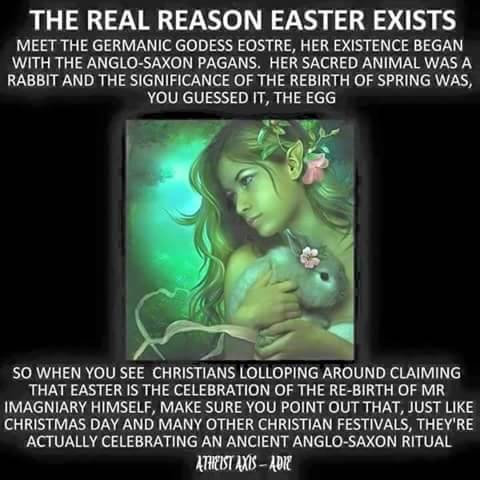
xians stole "easter," too
Really, all of christianity is stolen from earlier myths.
The Guardian:
Easter is a pagan festival. If Easter isn't really about Jesus, then what is it about? Today, we see a secular culture celebrating the spring equinox, whilst religious culture celebrates the resurrection. However, early Christianity made a pragmatic acceptance of ancient pagan practises, most of which we enjoy today at Easter. The general symbolic story of the death of the son (sun) on a cross (the constellation of the Southern Cross) and his rebirth, overcoming the powers of darkness, was a well worn story in the ancient world. There were plenty of parallel, rival resurrected saviours too.The Sumerian goddess Inanna, or Ishtar, was hung naked on a stake, and was subsequently resurrected and ascended from the underworld. One of the oldest resurrection myths is Egyptian Horus. Born on 25 December, Horus and his damaged eye became symbols of life and rebirth. Mithras was born on what we now call Christmas day, and his followers celebrated the spring equinox. Even as late as the 4th century AD, the sol invictus, associated with Mithras, was the last great pagan cult the church had to overcome. Dionysus was a divine child, resurrected by his grandmother. Dionysus also brought his mum, Semele, back to life.In ironic twist, the Cybele cult flourished on today's Vatican Hill. Cybele's lover Attis, was born of a virgin, died and was reborn annually. This spring festival began as a day of blood on Black Friday, rising to a crescendo after three days, in rejoicing over the resurrection. There was violent conflict on Vatican Hill in the early days of Christianity between the Jesus worshippers and pagans who quarrelled over whose God was the true, and whose the imitation. What is interesting to note here is that in the ancient world, wherever you had popular resurrected god myths, Christianity found lots of converts. So, eventually Christianity came to an accommodation with the pagan Spring festival. Although we see no celebration of Easter in the New Testament, early church fathers celebrated it, and today many churches are offering "sunrise services" at Easter – an obvious pagan solar celebration. The date of Easter is not fixed, but instead is governed by the phases of the moon – how pagan is that?All the fun things about Easter are pagan. Bunnies are a leftover from the pagan festival of Eostre, a great northern goddess whose symbol was a rabbit or hare. Exchange of eggs is an ancient custom, celebrated by many cultures. Hot cross buns are very ancient too. In the Old Testament we see the Israelites baking sweet buns for an idol, and religious leaders trying to put a stop to it. The early church clergy also tried to put a stop to sacred cakes being baked at Easter. In the end, in the face of defiant cake-baking pagan women, they gave up and blessed the cake instead.Easter is essentially a pagan festival which is celebrated with cards, gifts and novelty Easter products, because it's fun and the ancient symbolism still works. It's always struck me that the power of nature and the longer days are often most felt in modern towns and cities, where we set off to work without putting on our car headlights and when our alarm clock goes off in the mornings, the streetlights outside are not still on because of the darkness.What better way to celebrate, than to bite the head off the bunny goddess, go to a "sunrise service", get yourself a sticky-footed fluffy chick and stick it on your TV, whilst helping yourself to a hefty slice of pagan simnel cake? Happy Easter everyone!
Friday, December 16, 2016
Tuesday, December 24, 2013
Jeebus-Free Christmas Traditions
confrontingbabble-on:
12 Christmas Traditions Even a Black-hearted Grinch of an Atheist Can Celebrate
by Valerie Tarico
Here are twelve traditions with ancient roots. If they have been adopted and adapted by those who choose this time of year to celebrate the birth of Christianity and so the birth of some of Christendom’s darker angels, don’t let that put you off. They can just as easily be adopted and adapted by those who have moved beyond belief.
For as long as history has been recorded, and probably much longer, human culture has been a work in progress. We beg and borrow and mix and match. We live on the creative edge of chaos. Adopt Solstice as your holiday of choice, or Festivus, if you like. Or create your own tradition. But don’t be afraid to claim the Christmas customs that are dear to you, and then shape them as fits, and then hand them down, newly polished, to your children. That is part of what it means to be human.
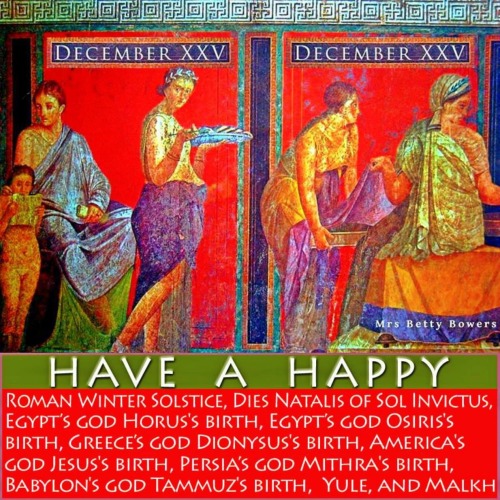
- Celebrating the End of December. All across the Northern Hemisphere our ancestors marked the winter solstice with festivals that acknowledge the cycle of life: death and birth, darkness and light. For cold, lean people it may have seemed like the sun might never reappear. Yet, a few days after solstice the days began to visibly lengthen, promising another spring. Persephone would return from Hades; King Winter would be beaten! Pagan Scandinavia celebrated Yule, the great turning of the wheel of life. The Roman Pope Julius 1 chose December 25 to honor the birthday of Jesus because it already hosted two related festivals of birth: natalis solis invicti (“birth of the unconquered sun”), and the birthday of Mithras, the “Sun of Righteousness.” Today, mid-winter celebrations in the month of December include the Buddhist Bodhi Day (December 8); Hannukah (December 8); Solstice itself, which has many names; Hindu Pancha Ganapati (December 21-25); Festivus (December 23), Kwanzaa (December 26-January 1), New Years Eve, and of course, Hogmanay.
- Candles & Lights
Since ancient times, man-made lights have symbolized the light of the sun and the promise of brighter days to come. We are told that pagan Romans decorated living trees with fragments of metal and images of the fertility god Bacchus. Twelve candles on a tree honored the sun god. The writings of one early Church father, Tertullian, discuss early Christians who imitated their neighbors by decorating their homes with candles and laurel at the turn of the year. In the North of Europe, Germanic people honored Woden by tying candles to evergreen branches, along with fruit. The Jewish festival of Hanukkah, a time of remembering, is centered on the menorah and is also called the Festival of Lights.
- Trees
For many Pagan peoples of Europe, evergreen trees were symbols of enduring life. Their branches had the power to fend off evil spirits. Druids held ceremonies while gathered around sacred trees. Cutting entire trees and bringing them indoors may have been too destructive, but we know that Pagans brought in evergreen boughs. Because trees are so strongly associated with Pagan celebrations some Christians have opposed them being a part of Christmas festivities. The first record of a decorated Christmas tree dates to 1521, in Germany. At the time, a prominent Lutheran minister protested: “Better that they should look to the true tree of life, Christ.” But the appeal of evergreen branches indoors is so universal that it has since been adopted through much of Christianity and into some homes for the celebration of the Jewish Hanukkah.
- Wreaths
In Scandinavia, the traditional Yule wreath symbolized the “Wheel of the Year,” which was also honored around the calendar with festivals marking winter and summer solstice and each equinoxes. Some ancient groups believed that the great wheel stopped turning at the point of the winter solstice and so it was taboo to turn a butter churn or wheel on the shortest day of the year. For Germanic people, wreaths decorated with small candles encouraged the return of spring: the circle of the wreath representing the seasons, and the candles representing warmth from the sun. When made of holly and ivy, a wreath was thought to provide protection to any household where it hung on the door.
- Santa
Given his ethnic roots, Santa Claus should be a symbol of multi-culturalism! His familiar form and story have been shaped most recently by 19th Century American and European media and marketers including the Bon Marche Department Store in Liverpool, Disney Studios, and Coca-Cola. They in turn drew on Scandinavian images of elves with red tunics and pointed hats, with sleighs and reindeer. Before that, the Italian/Greek/Spanish/Turkish story of St. Nicholas and the Germanic god Odin appear to have merged to create the Dutch figure, Sinterklaas, who rides through the sky on a white horse. His mischievous black-faced helpers listen at the chimneys to help him figure out whether children have been bad or good.
- Mistletoe
The magical status of Mistletoe goes so far back that it is lost in the mist of history. It played a role in Greek mythology and was likely the Golden Bough in the story of Aeneas. Across pagan Europe it was seen as a sacred symbol of male vitality and fertility. In one Norse story the goddess Frigga extracts a promise from each element and plant that it will not harm her son Balder, the god of the summer sun. But she overlooks the mistletoe, which lives not on the earth nor in the sky, but in between, in the arms of oak trees. The evil god Loki makes an arrow tip out of Mistletoe and gives it to Hoder, the blind god of winter, who kills Balder. For three days the other gods try in vain to restore him to life. Finally Frigga succeeds. Some versions of the story say that her tears turn into the mistletoe’s white berries and that afterwards Frigga kisses anyone who passes beneath a branch on which mistletoe grows.
- Holly
As Christianity spread across Europe, the red berries and spiny leaves of the holly plant became spiritual symbols representing the red blood of Jesus and his crown of thorns. But as with many other holiday favorites, Holly already had special meaning for local people. The familiar Christmas carol, “The Holly and the Ivy” contains vestiges of Celtic tradition in which a males and females were dressed in Holly and Ivy leaves and enacted a dance or ritual representing male and female energy. In the mythology of the British Isles, the Holly King was said to rule over the waning half of the year, from the summer solstice to the winter solstice, whereupon he fought with the Oak King, who ruled the season of planting and growth. In fact, the Holly King may be the Green Knight who Sir Gawain rose to fight at King Arthur’s Christmas feast.
- Feasting!
The Roman feast of Saturnalia lasted from December 17 through the 23. Picture a week-long progressive party in which normal roles are relaxed or reversed. At various times and places, white togas were replaced with colorful Greek garments, slaves dined with or before masters, and debauchery was widespread. But most of all, people ate. They ate at public banquets and private parties. Slaves ate foods normally reserved for the wealthy, and everyone ate well. Saturnalia recreated a mythical past in which bounty was the norm and all were free to indulge. The festival was popular enough that it may well have shaped early Christmas celebrations.
But the reality is that happy humans feast together in virtually every culture and religion on the planet, and feasting is a part of many mid-winter traditions. In some cultures food was offered to the gods to help ease the winter or bring back the sun. But few ancient people could afford to waste large quantities of meat once it had been consecrated, so it was roasted and eaten, with appropriate ritual, storytelling, song and dance. The Saami people of Finland sacrificed white female reindeer for their solstice celebration. Eastern Slavs celebrated the Feast of the winter mother goddess Rozhnitsa, at which deer shaped cookies were given as gifts and offerings to the goddess included honey bread and cheese . In Iran, families and friends gather for a solstice celebration called Shabe Chelleh, where traditional foods include dried fruits and nuts. Meat and ale were staples of the Germanic Yule feast.
- Mulled Wine & Cider
Some folks lament that wine is wasted by heating, but hot spiced wine and cider are long-standing staples of winter feasts. Traditional spices include cinnamon, mace, ginger, cloves, and orange, along with fortifications like black currant syrup and gin. Spiced wine dates back at least to the 1500s, when a version called “Hippocras” (named after Hippocrates) was sold to help heal muscle injuries. By early 1600, King Gustav I of Sweden was drinking a version of mulled wine he called “glodgad vin” known today simply as “glögg,” which means “to glow.” English villagers drank mulled cider while they went caroling or wassailing the apple orchards, where they banged together pots and pans to drive out evil spirits and then poured offerings of cider over tree roots.
- Gift Giving
The tradition of giving gifts at this time of year may owe some to the Roman god Saturn, patron of agriculture and plenty, and to his festival Saturnalia. For agricultural people, mid-winter can be a time of scarcity, and gift-giving during Saturnalia redistributed bounty from those who had excess to those who had little. Like feasting, though, giving gifts during celebrations is a tradition that has roots in many cultures, and perhaps even in biology. Our urge to give gifts is one that fascinates anthropologists, and one that many of us tackle with something between enthusiasm and exasperation. Whatever the roots, and however mixed we ourselves may feel, holiday merchants find the tradition a source of pure seasonal joy.
- Hearth Fires
Nothing says holiday cheer like an image of friends and family around a sparkling fireplace. The tradition of choosing a particularly hard, large log to burn, called the Yule log is a long-enduring English tradition that was adopted from the Germanic peoples of the Continent. British clergyman Robert Herrick wrote in the mid 17th Century that the young men who carried the log into the farmhouse were rewarded with free beer. With big enough fireplaces and dead trees and beer kegs this tradition alone might be enough to cheer some folks all the way through to the New Year.
- Last But Not Least, The Number Twelve
Twelve days of Christmasancient star worship! The number twelve has special significance in Judaism and Christianity. There are the twelve tribes of Israel, and the twelve disciples, and the 12,000 times 12 who, according to the book of Revelation, will make it into Heaven. Does that mean that those who have moved beyond belief should shun the number twelve? Absolutely not! Even the mythic significance of the number twelve has older roots, probably in the same that brought us the twelve signs of the zodiac and twelve months of the year and some parts of the Christmas story itself. Don’t forget the twelve feats of Hercules or the twelve Olympians. And perhaps you didn’t know about the twelve sons of Odin?
Valerie Tarico is a psychologist and writer in Seattle, Washington. www.WisdomCommons.org Awaypoint.Wordpress.com.

Friday, March 29, 2013
Monday, December 13, 2010
How the Freakazoids Stole Christmas
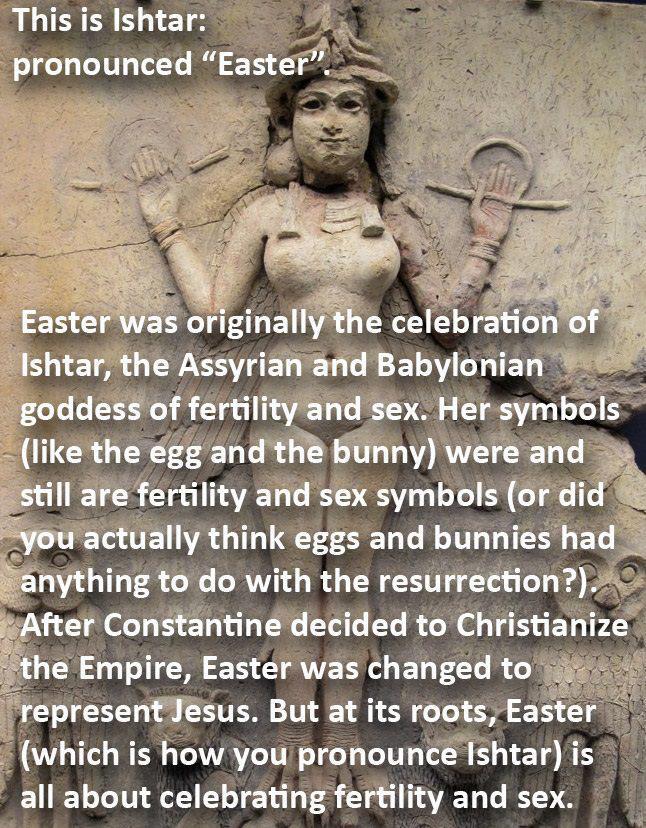
As Governor Beshear continues his unconstitutional and despicable promotion of an un-American Bronze Age myth, it's a good time to review the unprosecuted theft of the pagan midwinter festival by desperate early xians.
Overview:
Although nominally a Christian holiday, Christmas is also widely celebrated by many non-Christians, and many of its popular celebratory customs have pre-Christian or secular themes and origins. Popular modern customs of the holiday include gift-giving, music, an exchange of greeting cards, church celebrations, a special meal, and the display of various decorations; including Christmas trees, lights, garlands, mistletoe, nativity scenes, and holly. In addition, several similar mythological figures, known as Saint Nicholas, Father Christmas and Santa Claus among other names, are associated with bringing gifts to children during the Christmas season.
Yes, early church fathers took long-standing winter solstice festivals and just slapped a new name on them.
A winter festival was the most popular festival of the year in many cultures. Reasons included the fact that less agricultural work needs to be done during the winter, as well as an expectation of better weather as spring approached. Modern Christmas customs include: gift-giving and merrymaking from Roman Saturnalia; greenery, lights, and charity from the Roman New Year; and Yule logs and various foods from Germanic feasts. Pagan Scandinavia celebrated a winter festival called Yule, held in the late December to early January period. As Northern Europe was the last part to Christianize, its pagan traditions had a major influence on Christmas.Scandinavians still call Christmas Jul. In English, the word Yule is synonymous with Christmas, a usage first recorded in 900.
SNIP
The practice of putting up special decorations at Christmas has a long history. From pre-Christian times, people in the Roman Empire brought branches from evergreen plants indoors in the winter. Decorating with greenery was also part of Jewish tradition ...
The Christmas tree is often explained as a Christianisation of pagan tradition and ritual surrounding the Winter Solstice, which included the use of evergreen boughs, and an adaptation of pagan tree worship.
More information here.
The one part of modern Christmas that may be accurately attributed to christianity is the music, although I can't imagine that pagans never sang at Winter Solstice, nor Romans at Saturnalia.
So to all the "war on christmas" whiners, I say you can keep your music. But get your mythological mitts off my Winter Solstice evergreens, lights and decorations; your death-worship wizard away from my Saturnalia gifts and feasting, and your ludicrous "nativity scenes" out of my government buildings.
Subscribe to:
Comments (Atom)


 Posts
Posts


